Your pipeline looks active on paper, but your sales team is burning hours on prospects who were never going to buy. That gap – between lead volume and lead quality – is where most mid-market and enterprise revenue programs quietly bleed out.
Before you evaluate another lead generation platform, you need to understand what’s actually driving the problem. This case study-style breakdown walks through the real root cause, what a qualified-lead approach looks like in practice, and what Target AI Leads does differently – so you can make a clear-eyed decision rather than repeat the same expensive mistake.
Direct Answer
B2B companies struggling with poor lead quality and high acquisition costs typically have a targeting problem, not a volume problem. AI-powered lead generation works by identifying high-intent buyers based on behavioral signals and firmographic fit – not just contact lists. Evaluating any solution means asking whether it surfaces consultation-ready prospects or just fills a CRM with names.
Key Takeaways
• Lead volume without intent signals produces high activity and low conversion – the cost isn’t just wasted spend, it’s wasted sales capacity
• AI-powered targeting works by matching behavioral and firmographic data to your ideal customer profile before outreach begins
• The right evaluation question isn’t “how many leads can this generate?” – it’s “how many of these leads match the profile of a buyer who actually closes?”
• Platforms differ significantly in whether they prioritize data breadth or signal quality – those aren’t the same thing
• Realistic outcomes from a qualified-lead approach take weeks to stabilize, not days – any promise of instant results should be treated as a warning sign
What’s the Real Problem When Leads Don’t Convert?
You’ve probably run into this before: the pipeline looks full, the SDR team is hitting activity targets, and the CRM is loaded with contacts. But the close rate is flat, sales cycles are dragging, and your best reps are spending Monday mornings disqualifying leads that should never have entered the funnel.
The surface symptom is poor conversion. The actual problem is that most lead generation programs are built around contact acquisition, not buyer identification.
Filling a list and finding a buyer are not the same operation. One measures output. The other measures fit. When your program optimizes for the first, you get volume. When it optimizes for the second, you get pipeline that moves.
This distinction matters most at the mid-market and enterprise level, where a single misaligned deal cycle can consume months of sales capacity and produce nothing. The cost isn’t just the marketing spend – it’s the opportunity cost of every qualified conversation your team didn’t have because they were chasing the wrong one.
Why Does This Problem Keep Repeating Even After Platform Switches?
Most organizations that switch lead generation platforms carry the same targeting logic with them. They move from one contact database to another, update the filters, and expect different results. They don’t get them.
The root cause isn’t the platform. It’s the absence of intent-layer data.
Intent-layer data is the behavioral signal that indicates a prospect is actively researching a problem your product solves – not just matching a demographic profile. A VP of Sales at a 200-person SaaS company fits your ICP on paper. A VP of Sales at a 200-person SaaS company who has been consuming content about sales efficiency tools, evaluating competitors, and visiting pricing pages is a buyer.
Most traditional platforms surface the first type. AI-powered targeting is built to identify the second.
This is the structural reason the problem persists: organizations keep investing in better lists when what they need is better signals. The mechanism behind AI targeting isn’t magic – it’s the systematic use of behavioral, firmographic, and contextual data to score and rank prospects by actual purchase likelihood before a single message is sent.
What Does an AI-Powered Lead Generation Approach Actually Look Like in Practice?
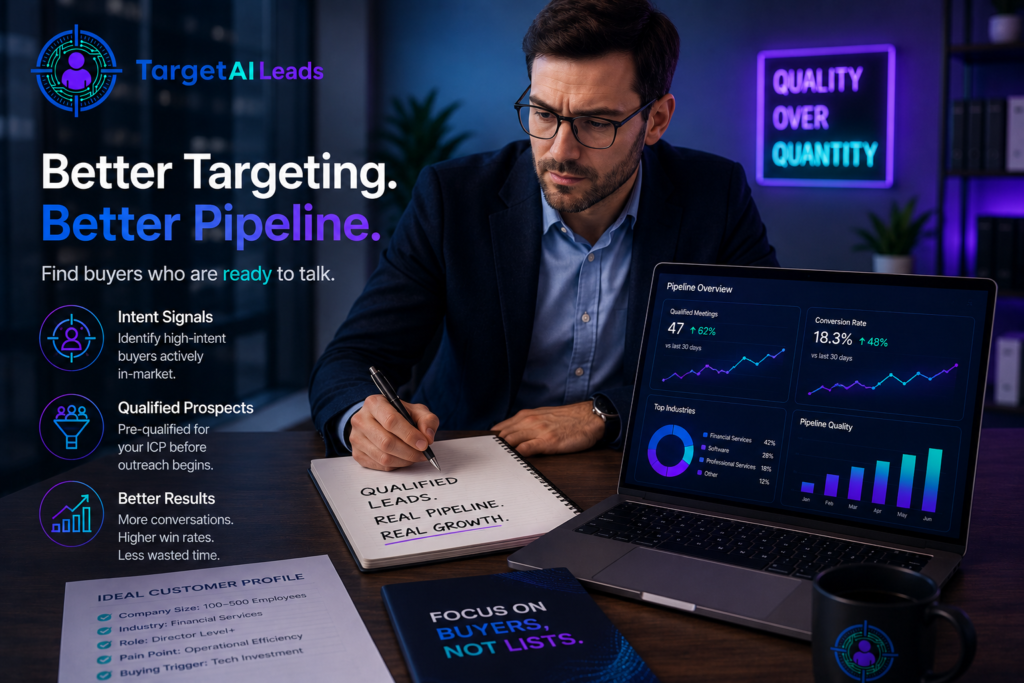
Consider a typical scenario: a mid-market B2B software company has a defined ICP – Director-level and above at companies with 100-500 employees in financial services. Their current approach pulls contact lists from a database, assigns them to SDRs, and measures success by email open rates and call connects.
The conversion rate from first contact to qualified meeting sits around 3-4%, which is industry-typical for cold outreach – but the sales team is burning through 200+ contacts per week to get there.
An AI-powered approach restructures this at the targeting stage. Instead of starting with a static list, the system builds a dynamic profile of high-intent accounts based on signals: recent technology adoption patterns, hiring activity in relevant roles, engagement with competitor content, and firmographic triggers like funding rounds or leadership changes.
The outreach volume drops. The qualified meeting rate climbs. Not because the messaging improved – because the targeting eliminated the noise before the first touchpoint.
Target AI Leads is built around this signal-first model. The platform doesn’t just identify who fits your ICP – it identifies who in your ICP is showing active buying behavior right now.
The Lead Quality Scorecard: How to Evaluate Any Solution Before You Commit
The Lead Quality Scorecard is a five-criteria evaluation framework for assessing whether a lead generation platform is built for contact acquisition or buyer identification. Use it before any vendor conversation.
Apply this when: you’re evaluating platforms at the mid-market to enterprise level and need to distinguish between data breadth and signal quality.
Don’t apply this when: you’re at the earliest stage of building any ICP at all – you need foundational market research before scoring applies.
| Evaluation Criterion | Contact Acquisition Platform | AI-Powered Buyer Identification |
| Data foundation | Static firmographic lists | Dynamic behavioral + firmographic signals |
| Targeting timing | Before intent is visible | After intent signals are detected |
| Lead scoring method | Manual rules or basic filters | Machine learning on engagement patterns |
| SDR time per qualified meeting | High – significant disqualification required | Lower – pre-qualified before handoff |
| Outcome metric | Leads delivered | Consultation-ready prospects identified |
The table isn’t about which platform has more data. It’s about when in the buyer journey the targeting happens. Identifying a prospect after they’ve signaled intent is a fundamentally different operation than identifying them because they match a demographic filter.
What Realistic Outcomes Look Like – and What They Don’t
Practitioners working with intent-based targeting consistently report a shift in the profile of inbound pipeline – fewer contacts, more qualified conversations. The mechanism is straightforward: when you remove low-intent prospects from the top of the funnel, your conversion metrics at every downstream stage improve, because the denominator is smaller and better-fit.
What this doesn’t mean: instant results, guaranteed close rates, or a pipeline that fills in the first week.
Realistic stabilization for a new AI-powered targeting program typically takes several weeks as the system calibrates against your ICP and refines its signal weighting. Organizations that expect overnight transformation usually measure too early and draw the wrong conclusions.
The honest framing: you’re not buying leads. You’re buying a more accurate picture of who in your market is ready to have a conversation – and that picture gets sharper over time, not all at once.
Target AI Leads is transparent about this. The value isn’t in the volume of contacts delivered on day one. It’s in the reduction of wasted sales capacity over the following quarter.
Who Is This Approach Not Right For?
Straight talk matters here.
AI-powered lead generation is least effective when your ICP isn’t defined. If you can’t describe your ideal customer in specific firmographic and behavioral terms – company size, industry, role, triggering event – then no targeting system can identify them accurately. The platform amplifies a clear signal. It can’t create one from scratch.
It’s also a poor fit if your sales cycle is entirely inbound and referral-driven with no capacity or appetite for outbound engagement. The intent-signal model assumes you’re reaching out to prospects who haven’t yet found you – if your growth model doesn’t include that motion, the infrastructure doesn’t apply.
And if your team isn’t set up to act on qualified leads promptly, the advantage erodes. High-intent signals have a shelf life. A prospect showing active buying behavior today may have made a decision in three weeks. Speed-to-contact on qualified leads matters more than most organizations account for.
Frequently Asked Questions
How is AI-powered lead generation different from just buying a contact list?
A contact list gives you names that match a demographic profile – it doesn’t tell you whether those people are actively looking for what you sell. AI-powered targeting layers behavioral signals on top of firmographic data, so you’re reaching prospects who are showing purchase intent, not just fitting a description. The practical difference is in how much disqualification your sales team has to do before reaching a real conversation.
How long does it take to see results from an intent-based targeting program?
Most programs take several weeks to calibrate before the signal quality stabilizes – the system needs time to learn which behavioral patterns correlate with your actual buyers. Organizations that measure too early, in the first week or two, often underestimate the value because they’re looking at volume rather than conversion quality. The right metric to watch is qualified meeting rate, not total leads delivered.
What happens if our ICP isn’t clearly defined yet?
AI targeting amplifies a clear signal – it doesn’t build one from scratch. If your ICP is vague or untested, the first step is defining it with enough specificity that the system has something to match against. Target AI Leads can help with this as part of the setup process, but it requires honest input from your sales and marketing teams about who actually closes and why.
Is this only useful for outbound sales motions?
Primarily, yes. The intent-signal model is built for identifying and reaching prospects who haven’t yet found you. If your entire growth model is inbound referrals and you have no outbound capacity, the infrastructure doesn’t add much. But most mid-market and enterprise teams run a blended motion – and the outbound component is usually where the most capacity is being wasted on low-fit prospects.
How does Target AI Leads compare to platforms like ZoomInfo or Apollo?
ZoomInfo and Apollo are strong contact database tools – they’re built for breadth of data. Target AI Leads is built around signal quality and intelligent targeting, which means the emphasis is on identifying who’s ready to buy rather than who exists in a database. The right question isn’t which platform has more contacts – it’s which one reduces the disqualification burden on your sales team.
What does “consultation-ready” actually mean in practice?
A consultation-ready prospect is someone who matches your ICP and is showing active behavioral signals of purchase consideration – not just a name that fits a filter. In practice, it means your SDR’s first call is a qualification conversation with someone who already has context and intent, rather than a cold interruption to someone who’s never thought about your category.
Can smaller sales teams use this effectively, or is it built for enterprise?
It works for mid-market sales teams, but the value scales with how much sales capacity you’re currently wasting on disqualification. A team of three SDRs burning 60% of their time on low-fit prospects has a lot to recover. A solo founder doing outreach manually has a different problem. The sweet spot is a team that already has an outbound motion and wants to make it more precise – not a team that’s building outbound from zero.
Stop Measuring the Wrong Thing
Most lead generation programs are measured by the wrong metric. Volume is easy to count. Qualified pipeline is what actually moves revenue.
The most expensive decision in B2B lead generation isn’t choosing a platform that costs too much – it’s running an inefficient targeting program for another quarter while your sales team’s capacity drains on prospects who were never going to close.
If you’ve read this far, you already know your current approach has a targeting problem. The next step isn’t another demo of another contact database. It’s a conversation about what your ICP actually looks like in behavioral terms – and whether your current program is built to find those people or just fill a list.
Contact Target AI Leads to talk through what qualified-lead targeting looks like for your specific sales motion. Come with your current conversion metrics – that’s where the real conversation starts.
About the Author
Target AI Leads is an AI-powered lead generation and targeting platform specializing in helping B2B companies identify and reach their ideal customers through intelligent audience targeting and data-driven insights. They work with sales directors, marketing managers, and growth teams at mid-market to enterprise organizations to improve lead quality, reduce wasted sales capacity, and build pipeline that converts. Their approach centers on signal-quality targeting – finding buyers who are ready to have a conversation, not just contacts who fit a demographic filter.