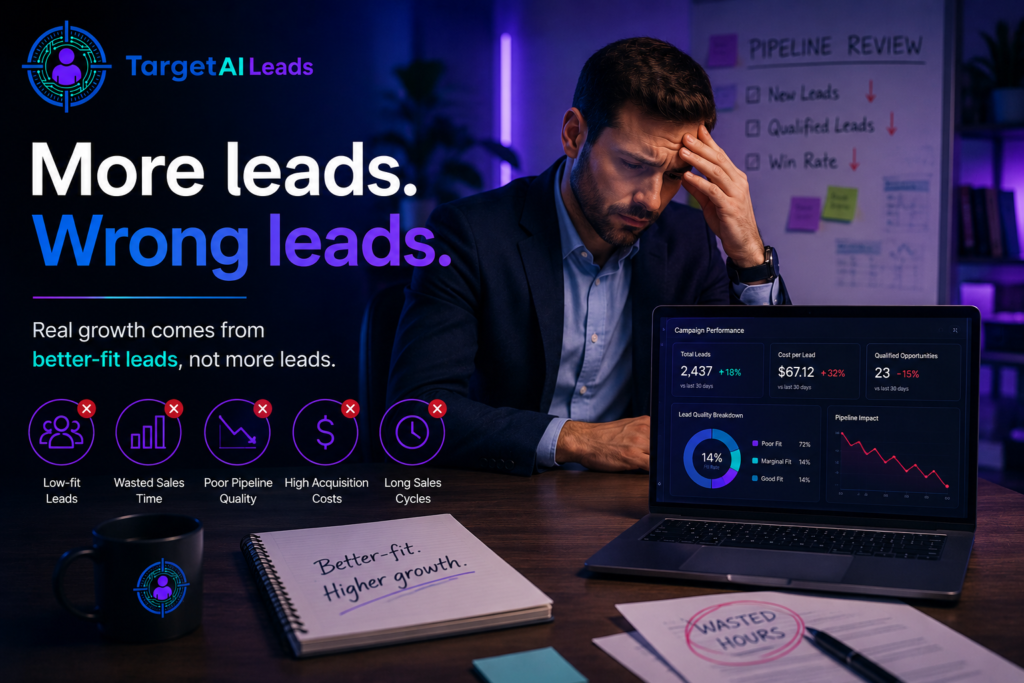
More leads are not the answer when the leads you’re already getting aren’t converting. If your sales team is spending hours on prospects who were never going to buy, the problem isn’t effort – it’s that the system feeding them was built for volume, not fit.
Direct Answer
Conventional digital marketing fails B2B teams because it was designed for consumer behavior, not enterprise buying cycles. The core breakdown: it optimizes for clicks and impressions while B2B revenue depends on qualified pipeline. Poor lead quality, high acquisition costs, and slow sales cycles aren’t execution problems – they’re structural failures baked into how most digital marketing tools measure success.
Key Takeaways
• Most B2B lead generation tools measure the wrong thing – impressions and clicks instead of pipeline contribution and close rate
• Broad audience targeting is the single biggest driver of wasted sales time in mid-market and enterprise teams
• The buying committee problem makes single-contact outreach structurally ineffective, regardless of message quality
• AI-powered targeting works differently because it filters on intent signals and fit criteria before a lead ever enters your CRM
• The cost of bad leads isn’t just the acquisition spend – it’s the compounded cost of sales hours spent on prospects who can’t buy
Why Does Your Lead Volume Keep Going Up While Pipeline Quality Goes Down?
This is the most common frustration sales directors and VPs report – and it’s not a coincidence. It’s the direct result of how conventional digital marketing tools are architected.
Most platforms optimize for what they can measure easily: form fills, click-through rates, cost per lead. These are real numbers. They’re just not the right numbers for B2B. A marketing team hitting its MQL targets while the sales team misses quota isn’t a communication problem. It’s a measurement misalignment baked into the tools themselves.
The mechanism matters here. When a platform rewards you for volume, it trains your campaigns to cast wider nets. Wider nets catch more leads. More leads look like progress. But in B2B, where a single deal can take three to twelve months and involve five to ten stakeholders, a “lead” who doesn’t match your ICP (Ideal Customer Profile) doesn’t just fail to convert – it actively consumes the sales capacity you need for the deals that will close.
Consider a typical mid-market software company running paid search campaigns. Their cost per lead looks reasonable on paper. But when the sales team tracks where closed revenue actually came from, a significant share of their pipeline originated from a handful of accounts that matched tight firmographic and behavioral criteria – not the broad keyword targeting driving most of their lead volume. The campaigns generating the most leads were generating the least revenue.
That’s not an edge case. Practitioners across B2B consistently report the same pattern.
What’s Actually Causing the Problem – Not Just the Symptoms
The root cause isn’t bad creative or poor targeting execution. It’s a category mismatch: conventional digital marketing was built for B2C buying behavior, then adapted for B2B without fixing the underlying assumptions.
B2C buying is individual, fast, and emotion-influenced. B2B buying is collective, slow, and risk-managed. When you run a B2B campaign through tools optimized for B2C behavior, you get leads who look engaged but aren’t ready to buy – and often can’t buy without consensus from people who never touched your campaign.
This is the buying committee problem. According to Gartner research on B2B purchase decisions, the typical buying group for a complex B2B solution involves six to ten decision-makers. Single-contact outreach – the default mode for most digital marketing funnels – doesn’t fail because the message is wrong. It fails because it’s structurally incapable of addressing a multi-stakeholder decision.
Most lead generation tools don’t know who else is in the room. They capture one contact and call it a lead.
The Five Structural Failures – Named and Explained
These aren’t symptoms. They’re the specific architectural reasons conventional approaches break down.
1. Optimizing for lead quantity over lead fit
Volume-based metrics create a perverse incentive: the more you optimize for cost per lead, the more you’re rewarded for attracting low-intent, poor-fit contacts. Fit – the degree to which a prospect matches your ICP on firmographic, behavioral, and intent criteria – is what actually predicts close rate. Most conventional tools don’t score for fit at all.
2. Static audience definitions
Most B2B campaigns define their audience once, at setup, then run. But buyer behavior shifts. A company that wasn’t in-market three months ago may be actively evaluating now. Conventional targeting has no mechanism to detect that shift. You’re fishing in the same pond regardless of where the fish actually are.
3. Single-channel attribution distorting spend decisions
Last-click attribution – still the default in many platforms – credits the final touchpoint before conversion and ignores everything that built the case for buying. This causes teams to over-invest in bottom-funnel channels and underinvest in the earlier-stage content and targeting that actually moved the prospect toward a decision.
4. No separation between traffic intent and purchase intent
Someone reading a blog post about your category is not the same as someone comparing vendors. Conventional digital marketing tools treat both as leads if they fill out a form. The behavioral signals that distinguish curiosity from active evaluation exist – but most platforms don’t surface them.
5. Disconnection between marketing data and sales reality
Marketing hands off a lead. Sales works it. If it doesn’t close, the data rarely flows back to inform the next campaign. The feedback loop is broken. So the same targeting mistakes repeat, compounding cost and eroding sales team trust in marketing-sourced leads over time.
How AI-Powered Targeting Changes the Equation
AI-powered lead targeting is not a faster version of the same approach. It’s a different kind of solution – one that operates on fit signals before a lead enters your pipeline, rather than after.
Where conventional tools ask “who clicked?”, AI targeting asks “who matches the profile of accounts that actually close?” The distinction sounds simple. The operational difference is significant.
Target AI Leads applies machine learning to identify high-intent prospects based on behavioral signals, firmographic fit, and intent data – not just demographic overlap. The result is a shorter list of better-fit contacts rather than a longer list of marginally interested ones. That shift changes the economics of every downstream sales activity.
The most expensive lead isn’t the one with the highest acquisition cost. It’s the one your sales team spent three weeks qualifying before disqualifying.
When sales development reps work a tighter, better-qualified list, their connect rates improve, their conversion rates improve, and – critically – their confidence in the pipeline improves. That last point matters more than most marketing teams realize: SDR morale and persistence are directly affected by how often their outreach lands with someone who actually fits.
Conventional Targeting vs. AI-Powered Targeting: What Actually Differs
| Factor | Conventional Digital Marketing | AI-Powered Targeting (Target AI Leads) |
| Audience definition | Static, set at campaign launch | Dynamic, updated on behavioral and intent signals |
| Lead scoring | Volume-based, form-fill triggered | Fit-based, multi-signal before CRM entry |
| Buying committee visibility | Single contact captured | Account-level signals across stakeholders |
| Feedback loop | Rarely closes back to campaign | Continuous learning from pipeline outcomes |
| Sales team experience | High volume, low trust in leads | Lower volume, higher conversion confidence |
| Cost framing | Cost per lead | Cost per qualified opportunity |
The table above isn’t about price. It’s about what you’re actually buying. Conventional tools sell you leads. Target AI Leads is built to deliver qualified enquiries – contacts who match your ICP and show behavioral signals consistent with active evaluation.
Who This Approach Is Built For – And Where It Fits Less Well
Target AI Leads is most valuable when the cost of a bad lead is high. That means mid-market to enterprise B2B companies with complex sales cycles, defined ICPs, and sales teams whose time is genuinely expensive.
If your average deal size is small and your sales motion is transactional, the economics of precision targeting are harder to justify – volume may genuinely be the right strategy. But if a single misqualified prospect costs your team ten hours of outreach, discovery, and proposal work, the math shifts decisively toward fit over volume.
This approach also requires that you have a reasonably clear ICP. AI targeting amplifies your targeting criteria – it doesn’t invent them. If you haven’t defined what a good customer looks like in behavioral and firmographic terms, that’s the work that needs to happen first.
Frequently Asked Questions
How do I know if our lead quality problem is a targeting issue or a sales execution issue?
If your leads are converting from discovery calls at a low rate and sales reps consistently report that prospects “weren’t a fit,” the problem is upstream of sales – it’s targeting. If leads are fit but stalling later in the cycle, that’s more likely a sales process or deal structure issue. The diagnostic is simple: track ICP match rate at the point of lead creation, not just at close.
We’re already using a major data provider. Why isn’t that solving the quality problem?
Data providers give you access to contacts. They don’t filter for intent or behavioral fit. Having a large, accurate database is a starting point – it’s not a targeting strategy. The gap between “this person exists and has a relevant title” and “this person is actively evaluating a solution like ours” is where most lead quality problems live.
How long before we’d see a difference in pipeline quality with AI-powered targeting?
Realistically, you’d expect to see changes in lead-to-opportunity conversion rates within one to two quarters as the system learns from your pipeline outcomes. The first month typically surfaces the targeting refinements; the second and third months show the pipeline impact. Honest answer: it’s not instant, and anyone promising dramatic results in two weeks is overselling.
Won’t a smaller lead list make our sales team nervous about pipeline coverage?
It will, initially. SDRs and sales managers are conditioned to equate volume with safety. The shift requires showing them conversion rate data alongside volume data – when a smaller list produces the same or more qualified opportunities, the resistance fades. The goal isn’t fewer leads. It’s fewer wasted hours per closed deal.
Does this work for companies that sell to multiple verticals?
Yes, but it works better when each vertical has a distinct ICP profile. AI targeting performs best when the fit criteria are specific. If you’re selling to three different buyer types with different pain points and buying triggers, those should be treated as three separate targeting models, not one broad campaign.
How is Target AI Leads different from what Apollo.io or ZoomInfo already offer?
Apollo and ZoomInfo are primarily data and contact access platforms. They give you the list. Target AI Leads is built around intelligent targeting and qualification – identifying which contacts on that list are actually worth reaching, based on intent signals and fit criteria, before your sales team touches them. The difference is between a directory and a recommendation engine.
What happens to our existing CRM data when we start using AI-powered targeting?
Your existing CRM data is an asset, not a liability. Historical pipeline data – what converted, what didn’t, how long deals took – is exactly the input that makes AI targeting more accurate over time. The more your system knows about what a good customer looks like in your specific context, the better it gets at finding more of them.
If you’ve read this far, you’re probably sitting with a specific number in your head – the hours your team spent last quarter on leads that were never going to close. That’s the cost worth fixing. Contact Target AI Leads to talk through what better-fit lead targeting would look like for your pipeline specifically.
About the Author
Target AI Leads is an AI-powered lead generation and targeting platform built for B2B companies that need qualified enquiries, not just contact volume. They work with sales directors, marketing managers, and growth teams at mid-market to enterprise organizations to improve lead quality, reduce wasted sales hours, and build pipeline from prospects who actually match their ideal customer profile.